
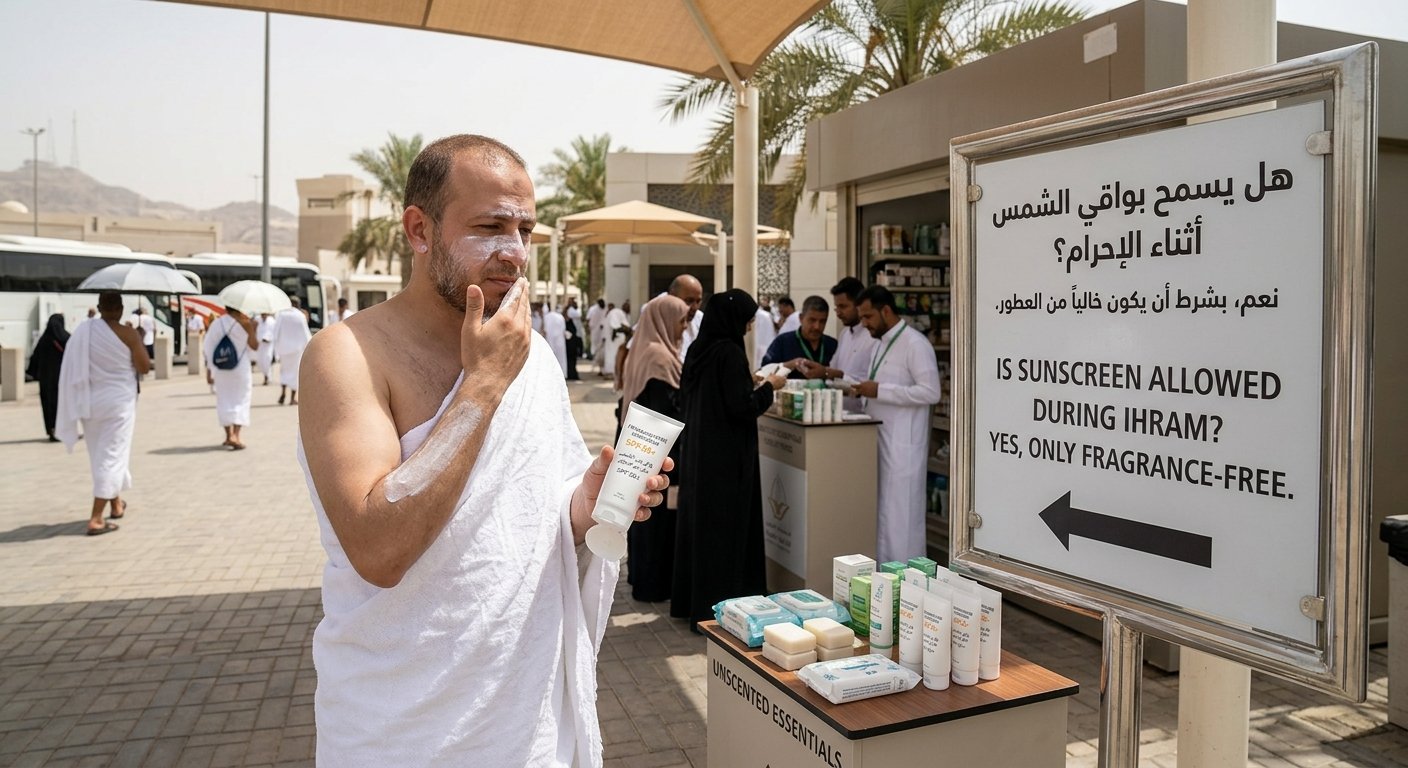
Is Sunscreen Allowed During Ihram?
Every year, thousands of pilgrims ask the same practical question while packing for Makkah: can I wear sunscreen in Ihram? The short answer is yes, as long as the product is completely fragrance-free. The restriction in Ihram is on perfume and scented products, not on protecting your skin from harmful sun exposure.
Hajj and Umrah involve long hours outdoors. Tawaf in open areas, Sa’i, walking between sites, waiting in queues and standing in Arafat all expose your skin to strong sunlight for many hours at a time. Without protection, painful sunburn, dark patches and dry, peeling skin are very common. This guide explains what is allowed, how to choose the right product, and how to use it properly so you can focus on your ibadah and not on your skin.
Why Sun Protection Matters More in Hajj and Umrah
The sun in Saudi Arabia is intense, and temperatures in Makkah can cross 40°C in the hot months. UV rays are strongest in the middle of the day, which is exactly when many pilgrims are moving between holy sites. Several things make skin more vulnerable during the pilgrimage:
- Long outdoor hours: Many rituals take place in open spaces with little shade.
- Uncovered head for men: Men in Ihram do not cover their heads, so the scalp, forehead, ears and face are fully exposed.
- Reflective surfaces: White marble floors and light-coloured buildings reflect sunlight back onto the skin.
- Sweat and dehydration: Sweating can wash away sun protection faster than you expect.
- Unfamiliar climate: Pilgrims from cooler places are often not used to this level of heat and UV.
For many people, sunscreen is not a luxury or a beauty product. It is a basic health measure, the same way drinking water is.
What the Ihram Rule Actually Says
Islamic jurisprudence is clear that applying perfume or fragrance to the body or clothing after entering Ihram is not permitted. Scholars of the major schools discuss this under the prohibitions of Ihram, and a fidyah may be required in certain cases. However, the prohibition concerns fragrance, not skincare in general.
A sunscreen that contains no added scent is simply a protective product. This is why scholars and experienced mu’allims generally advise pilgrims to use fragrance-free products rather than avoid them altogether. The issue, in practice, is that many popular sunscreens contain perfume to cover the smell of their active ingredients.
That means the label matters far more than the brand name or the SPF number. For rulings specific to your madhab or situation, always check with a qualified scholar.
Why Many Sunscreens Contain Fragrance
If you pick up an ordinary sunscreen from a shop in Pakistan, there is a good chance it contains “parfum”. Manufacturers add fragrance because chemical sun filters can have an unpleasant smell, and a pleasant scent makes the product feel more appealing. Beach and holiday sunscreens in particular are often scented with coconut, vanilla, citrus or floral notes.
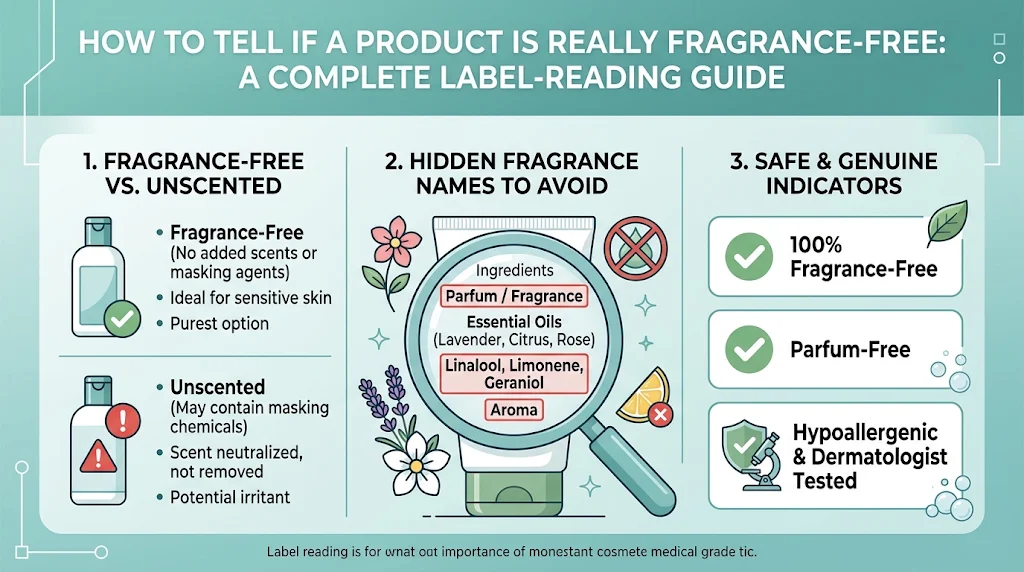
Some products are labelled “unscented”, which sounds safe but is not always the case. Certain unscented products contain a masking fragrance that cancels out the smell of other ingredients. For Ihram, fragrance-free is the safer and clearer choice. We explain this difference in detail in our guide on fragrance-free vs unscented.
How to Read a Sunscreen Label for Ihram
Before you pack any sunscreen, check the ingredient list carefully. Put the product aside if you see any of these:
- Parfum or fragrance
- Essential oils such as lavender, citrus, rose, sandalwood or ylang-ylang
- Floral extracts
- Terms such as “scented”, “fresh scent” or “tropical aroma”
- Common fragrance allergens like linalool, limonene, geraniol or citronellol (these are often added for scent)
A good Ihram-safe sunscreen will usually say “fragrance-free” clearly on the front of the pack and will have a short, simple ingredient list.
Mineral vs Chemical Sunscreen: Which Is Better for Pilgrims?
Mineral Sunscreen
Mineral sunscreens use zinc oxide or titanium dioxide. They sit on top of the skin and reflect UV rays. Many people with sensitive or easily irritated skin find them gentler. They also start protecting right away after application.
Chemical Sunscreen
Chemical sunscreens absorb UV rays and convert them into heat. They are often lighter in texture and leave less white cast, but some people find that they sting the eyes when sweating and may irritate sensitive skin.
For Hajj and Umrah, where you will be sweating, walking and rubbing your face, a gentle mineral formula is often a good choice. Whichever type you choose, the key requirement for Ihram is that it must be fragrance-free.
Choosing the Right SPF
Most dermatologists recommend at least SPF 30 for daily use. For long hours in strong sun, SPF 50 gives extra confidence. Look for these features:
- Broad spectrum: Protects against both UVA and UVB rays.
- Water or sweat resistant: Helps it stay on the skin longer when you sweat.
- Non-greasy texture: Easier to wear in heat and humidity.
- Suitable for sensitive skin: Reduces the chance of redness or stinging.
Remember that a higher SPF does not mean you can skip reapplying. Even SPF 50 wears off with sweat, rubbing and time.
Shop Fragrance-Free Sunblock at Fragrance Free Care: Fragrance-Free Sunblock
How to Apply Sunscreen Properly During Hajj and Umrah
Using sunscreen correctly matters as much as choosing the right one. Follow these steps:
- Apply before you go out. Put it on about 15 to 20 minutes before stepping outside so it can settle on the skin.
- Use enough. Most people apply too little. A generous amount for the face and neck, and enough to cover each arm and leg, is needed.
- Cover all exposed areas. Face, neck, ears, hands, forearms and the tops of the feet are often missed.
- Reapply every two hours. Sweat, wiping and touching the face remove sunscreen quickly.
- Reapply after heavy sweating. If you have been walking for a long time or have washed your hands and face for wudu, put on a fresh layer.
- Keep a small tube with you. A travel-size tube in your Ihram bag makes reapplication easy.
Special Tips for Men
Because men do not cover the head in Ihram, the scalp, forehead and ears get very high exposure. Apply sunscreen carefully around the hairline, ears and the back of the neck. Many scholars permit using an umbrella for shade, which is a very helpful way to reduce sun exposure on the head. Please confirm this with your group’s scholar or guide.
Special Tips for Women
Women generally keep the face uncovered according to the rules of Ihram while observing modesty, so the face often takes most of the sun exposure. Apply sunscreen to the face, neck and hands, and reapply regularly. Use a gentle formula that does not leave a heavy residue under a scarf or headcover.
Common Mistakes Pilgrims Make With Sunscreen
- Packing the same scented sunscreen used at home. Always check the label again before travel.
- Buying a beach sunscreen with coconut or floral scent. These are very likely to contain fragrance.
- Applying only once in the morning. One layer will not last through a full day of walking.
- Skipping sunscreen on cloudy or hazy days. UV rays still reach the skin.
- Forgetting the feet. Sunburn on the tops of the feet is painful and makes walking harder.
- Trying a new product for the first time on the trip. Test it at home first to make sure it does not irritate your skin.
Soothing Your Skin After a Long Day
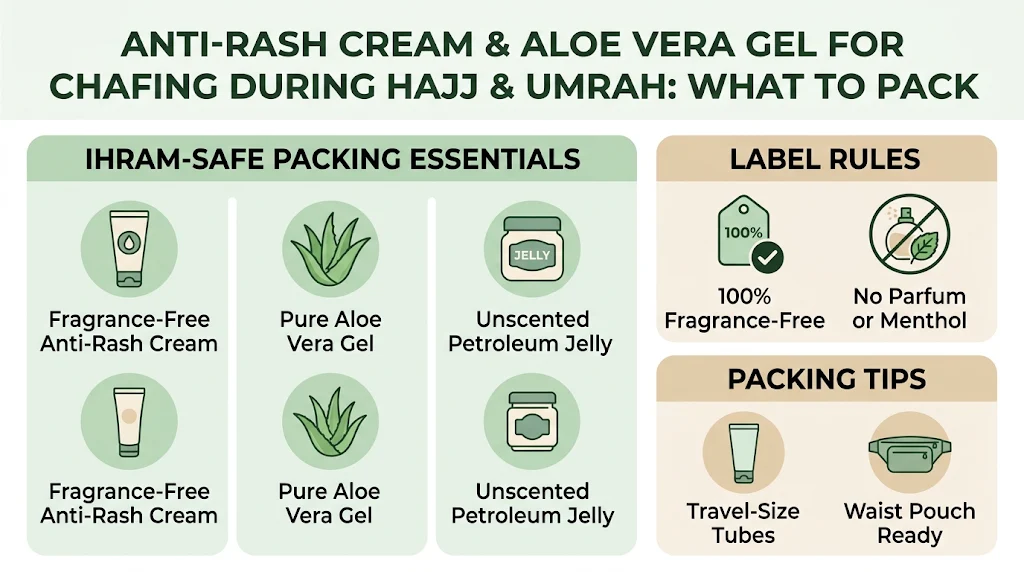
Even with good sunscreen, skin can feel warm, tight and dry at the end of the day. Cool the skin with gentle washing and apply a pure, fragrance-free aloe vera gel to soothe and hydrate it. Follow with a fragrance-free moisturizer if your skin feels dry.
Shop Fragrance-Free Aloe Vera Gel at Fragrance Free Care: Fragrance-Free Aloe Vera Gel
Shop Fragrance-Free Body Lotion at Fragrance Free Care: Fragrance-Free Body Lotion
What to Do If You Get Sunburned
If you do get sunburned despite your efforts:
- Get out of the sun as soon as possible and rest in a shaded or cool place
- Drink plenty of water
- Apply fragrance-free aloe vera gel to the affected skin
- Avoid scrubbing, peeling or popping blisters
- Seek medical help if the burn is severe, blistering widely, or you feel dizzy, feverish or unwell
Heat exhaustion and heatstroke are serious. If you feel very weak, confused, or stop sweating, get medical help immediately.
Quick Sunscreen Checklist for Your Ihram Bag
- Fragrance-free sunblock (SPF 30 or higher, ideally 50)
- Small travel-size tube for daily carrying
- Fragrance-free aloe vera gel for after sun
- Fragrance-free moisturizer
- A patch test done at home before travel
For an easy all-in-one option, see our complete kit below.
Frequently Asked Questions
Can women use sunscreen in Ihram? Yes. The same rule applies to men and women: the product must be fragrance-free.
Can I use a sunscreen stick or spray? Yes, if there is no fragrance. Check the label carefully, because sprays often contain added scent.
Is “unscented” sunscreen allowed? Not always. Some unscented products use masking fragrance. Choose products that are clearly labelled fragrance-free.
What if I used a scented product by mistake? Stop using it, wash it off, and ask a qualified scholar about your situation, since rulings can depend on intention, knowledge and madhab.
Can I apply sunscreen before entering Ihram? Many pilgrims apply fragrance-free products before entering Ihram as part of their preparation. As always, avoid any product with fragrance, since lingering scent can be an issue.
Conclusion
Protecting your skin during Hajj or Umrah is not against Ihram. It is part of caring for the body Allah has entrusted to you. Choose a certified fragrance-free sunblock, apply it generously, reapply regularly, and take care of your skin at the end of the day. When your skin is comfortable, you can give your full attention to your worship.
At Fragrance Free Care, every product we sell is formulated without fragrance, so you can pack with confidence. See also our guide on what skincare products are allowed during Ihram.
Shop the Complete Hajj & Umrah Kit at Fragrance Free Care: Fragrance-Free Hajj & Umrah Kit
This article is for general guidance and is not medical advice. For rulings specific to your madhab or situation, please consult a qualified scholar.
1 Comment